281-772-9069 info@brilliancenutrition.com
Omega-3 fish oil remains one of the highest-volume nutritional raw materials in the North American dietary supplement market, driven by sustained demand for cardiovascular, cognitive, and prenatal health support. For brand owners, contract manufacturers, and bulk raw material purchasers, the critical distinction between triglyceride (TG), ethyl ester (EE), and re-esterified triglyceride (rTG) molecular forms directly impacts product bioavailability, production costs, label compliance, and end-user satisfaction. While all three deliver the core active ingredients EPA and DHA, their structural differences create wide gaps in absorption efficiency, purity ceilings, oxidative stability, and ideal use cases. To support full portfolio planning, this article also breaks down how fish oil compares to krill oil and algae oil — the two most common alternative omega-3 feedstocks. Below is a complete breakdown of chemical specifications, head-to-head performance differences, market-proven formulation blends, and local bulk inventory support to help B2B buyers select the right omega-3 grade for their product lines.
All fish oil raw materials derive their functional value from two essential omega-3 polyunsaturated fatty acids: eicosapentaenoic acid (EPA) and docosahexaenoic acid (DHA). These active compounds are identical across all three molecular forms; the difference lies in how the fatty acids are bonded to a carrier structure, which dictates processing characteristics and in vivo behavior.
In naturally occurring fish oil, EPA and DHA are bound to a glycerol backbone in triglyceride form. Industrial processing technologies have created two additional structural variants – ethyl ester and re-esterified triglyceride – each optimized for specific purity, cost, and performance targets. All grades referenced in this article meet USP monograph standards and comply with FDA GRAS guidelines for dietary supplement use in the United States.
Understanding the structural, processing, and performance profiles of each form is critical for aligning raw material selection with product positioning and target consumer segments.
Triglyceride fish oil is the molecular structure naturally present in wild deep-sea fish tissue, where EPA, DHA, and other common fatty acids are bonded to a single glycerol backbone with three fatty acid chains per molecule. Production involves relatively simple processing: cold pressing, crude refining, deodorization, and winterization, with no molecular rearrangement required. Typical omega-3 purity for standard TG fish oil ranges from 30% to 45% EPA+DHA; higher-purity natural TG oil is technically challenging to produce and carries a significant cost premium.
From a bioavailability standpoint, the TG structure is readily recognized by human digestive enzymes. Pancreatic lipase breaks the bonds efficiently, releasing free fatty acids and monoglycerides for direct intestinal absorption. This gentle digestion process delivers high tolerability, even on an empty stomach, with minimal risk of fishy aftertaste or gastrointestinal upset, making it ideal for sensitive populations such as pregnant women and users with weak digestion. The primary limitations are its lower purity ceiling and moderate oxidative stability, requiring nitrogen-flushed packaging to maintain shelf life.
Ethyl ester fish oil is a chemically modified variant produced through transesterification. Natural fish oil undergoes ethanolysis that cleaves fatty acid chains from the glycerol backbone and binds them to ethanol molecules, forming fatty acid ethyl esters. The core advantage of the EE structure is its compatibility with molecular distillation, which allows manufacturers to concentrate EPA and DHA to between 60% and 90%. The vast majority of high-potency prescription-strength omega-3 products on the US market use EE-grade fish oil due to its ultra-high purity and consistent batch-to-batch assay.
However, the ethyl ester structure is not a form naturally recognized by human digestive systems. Before absorption, the ester group must first be hydrolyzed in the intestinal tract, a process that depends heavily on bile salts and pancreatic lipase secretion. As a result, EE fish oil bioavailability is highly food-dependent: absorption is poor when taken fasted but improves significantly when consumed with dietary fat. EE oil offers superior oxidative stability compared to triglyceride forms and typically carries a lower cost per gram of EPA+DHA at high purity levels, making it a cost-effective choice for high-dose formulations.
Re-esterified triglyceride (rTG) fish oil is a two-step engineered form that combines the purification advantages of EE with the digestive compatibility of natural TG. Production first converts crude fish oil to ethyl ester for high-purity molecular distillation, then carries out a secondary esterification to reattach purified EPA and DHA chains back onto a glycerol backbone, reconstructing the triglyceride structure.
The result is a premium raw material with omega-3 purity ranging from 60% to 85%, matching the high concentration of EE grades while retaining the natural triglyceride configuration recognized by digestive enzymes. Bioavailability studies consistently show that rTG fish oil delivers absorption rates comparable to natural TG oil, with good absorption even under fasting conditions and significantly reduced fishy aftertaste relative to EE forms. The main tradeoff is higher production cost, driven by the additional processing step and lower yields. For compliance purposes, it is important to note that rTG is an industrially reconstructed structure, not a naturally sourced triglyceride, and product labeling should reflect this distinction accurately.
Across core metrics, rankings are clear: for bioavailability with food, rTG ≈ TG > EE; for fasting bioavailability, TG and rTG are substantially higher than EE; for oxidative stability, EE > rTG ≈ TG; for achievable purity, EE offers the highest ceiling, followed by rTG, with natural TG limited to lower concentration ranges.
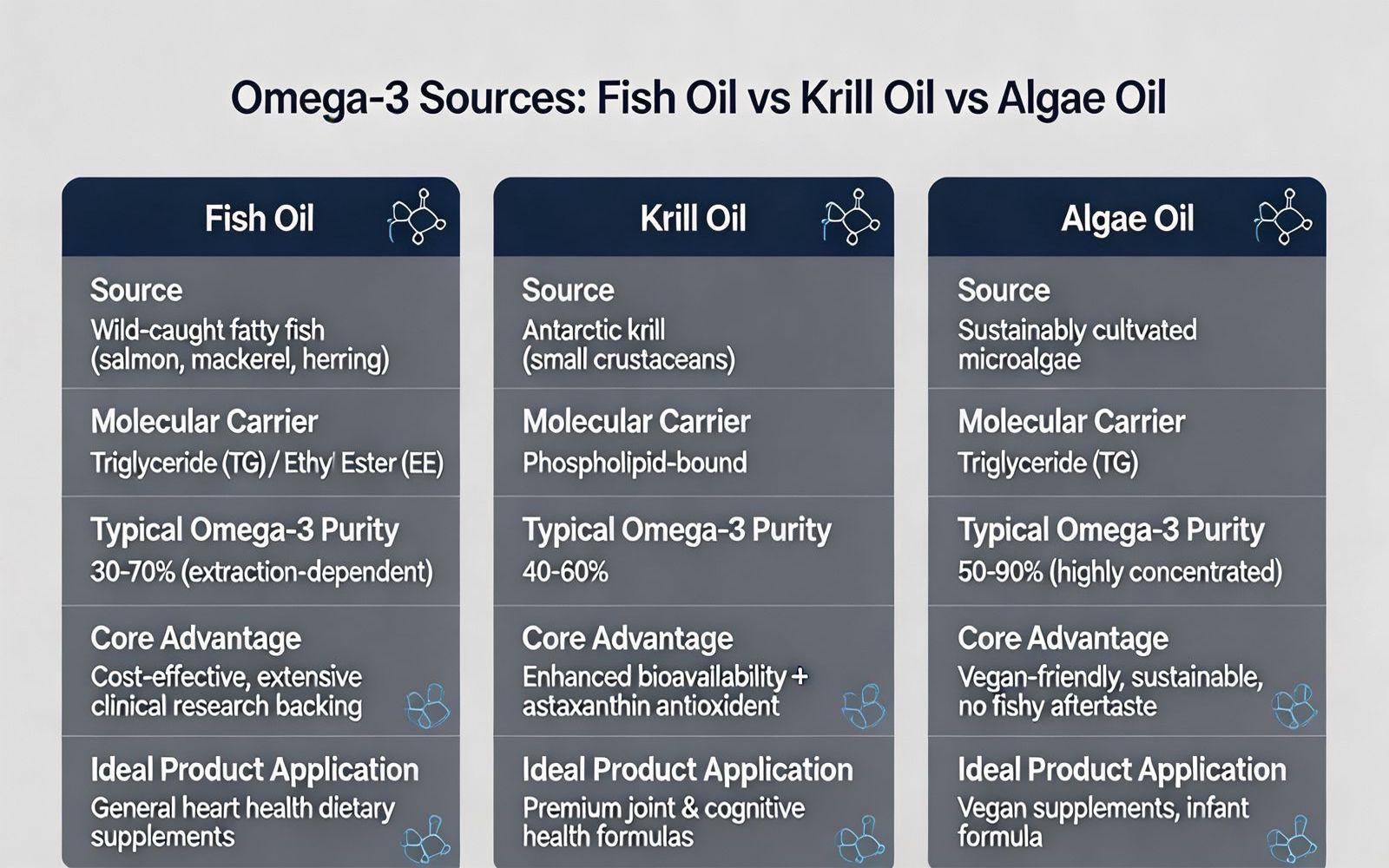
Beyond internal molecular variants, bulk ingredient buyers commonly evaluate three core omega-3 feedstocks to diversify product portfolios: fish oil, krill oil, and algae oil. Each differs in origin, active carrier structure, purity profile, and target market fit, making them suitable for distinct supplement line strategies.
Krill Oil (CAS 93165-61-2) is sourced from Antarctic krill, with EPA and DHA primarily bound to phospholipids rather than triglycerides. This phospholipid carrier supports enhanced cellular uptake, particularly across the blood-brain barrier, and naturally contains astaxanthin for built-in antioxidant support and improved oxidative stability. Typical total omega-3 content ranges from 15% to 25%, lower than most refined fish oil grades, and per-gram active costs are significantly higher. Krill oil is most commonly formulated into premium cognitive health, joint support, and anti-aging product lines, where superior absorption and clean-label positioning justify the price premium.
Algae Oil is a fermented plant-based omega-3 source produced from microalgae strains, most commonly rich in DHA with variable EPA content. DHA-rich algae oil typically assays 35%–50% DHA in triglyceride form, with zero fish-derived content, making it fully compliant with vegan, vegetarian, and halal dietary requirements. It carries a neutral flavor profile with no fishy aftertaste, reducing the need for flavor masking in finished products. The primary limitation for general omega-3 formulations is lower natural EPA content; high-EPA algae oil grades are available but carry a substantial cost premium. Algae oil is the standard raw material for plant-based omega-3 lines, prenatal and pediatric supplements, and clean-label vegan product portfolios.
For B2B sourcing decisions, the core tradeoffs align directly with product positioning: fish oil delivers the lowest cost per gram of EPA+DHA for mass-market cardiovascular and general wellness lines; krill oil targets premium absorption-focused and cognitive segments; algae oil serves vegan, specialty dietary, and pediatric markets where fish-free status is a non-negotiable requirement.
Fish oil is a versatile base ingredient across multiple supplement categories in the North American market. Below are the most common application segments and validated formulation combinations used by leading brands, tailored to different molecular form strengths.
Cardiovascular support is the largest application segment for omega-3 fish oil. For mass-market daily supplements, rTG fish oil is the premium choice, typically dosed at 1000mg per serving with 180mg EPA and 120mg DHA, paired with 100mg ubiquinone CoQ10 and 100mcg vitamin K2 (MK-7). This combination supports healthy lipid profiles and vascular endothelial function, with CoQ10 offsetting potential coenzyme depletion associated with long-term high-dose omega-3 intake. For high-potency products targeting elevated triglyceride levels, EE-grade fish oil with 80%+ EPA+DHA is the industry standard.
DHA is the primary structural fatty acid in brain and retinal tissue, making DHA-rich fish oil a staple for cognitive and vision health products. A typical premium brain health formula uses 750mg DHA-rich rTG fish oil (500mg DHA, 200mg EPA per gram) combined with 100mg phosphatidylserine and 20mg lutein. This blend supports memory function and retinal health, suitable for student, senior, and blue-light exposure consumer segments. The rTG form ensures consistent absorption even for users who take supplements between meals.
For prenatal supplement lines, natural TG fish oil is the industry standard due to its gentle digestive profile and low risk of aftertaste. A standard prenatal formulation includes 1000mg TG fish oil (200mg DHA, 100mg EPA) paired with 250mg choline bitartrate and 400mcg folic acid. DHA supports fetal neural and visual development, while choline and folic acid address core prenatal nutrient requirements. The natural TG form is well tolerated during morning sickness and can be taken without food, improving user adherence.
For contract manufacturers and supplement brands, reliable supply, consistent purity, and fast lead times are critical to maintaining production schedules and label compliance. We maintain regular ready-to-ship inventory of all three fish oil molecular forms in our Los Angeles, California warehouse, serving customers across the United States and Canada with domestic lead times of 2–5 business days.
Our stocked grades include natural TG fish oil in 30%, 40%, and 50% EPA+DHA assay options, EE fish oil in 60% to 90% purity grades including high-EPA and high-DHA specialized variants, and rTG fish oil in 50% to 80% assay ranges to cover entry-level to premium product lines. All lots are manufactured under cGMP conditions, tested for heavy metals, peroxides, and microbial contaminants, and accompanied by full Certificates of Analysis (COA) and third-party verification documentation, meeting USP and FDA dietary supplement requirements. We support both small-batch trial runs for new product development and full-scale bulk production orders, with flexible packaging options including drums, totes, and pre-blended bulk mixes.
TG, EE, and rTG fish oil each serve distinct roles in the dietary supplement market, with no single form universally superior to the others. The optimal selection depends on a brand’s target audience, purity requirements, price point, and product positioning. Natural TG excels for gentle, cost-effective daily supplementation; EE delivers unmatched purity for high-dose therapeutic applications; and rTG combines high concentration with superior absorption for premium product lines. When expanding omega-3 portfolios, krill oil and algae oil offer clear pathways into premium and specialty dietary segments. By aligning molecular form and source selection with product goals, B2B buyers can develop compliant, effective, and market-competitive omega-3 supplements. Our Los Angeles-based bulk inventory and technical support team are ready to help you source the right fish oil grade for your next product.